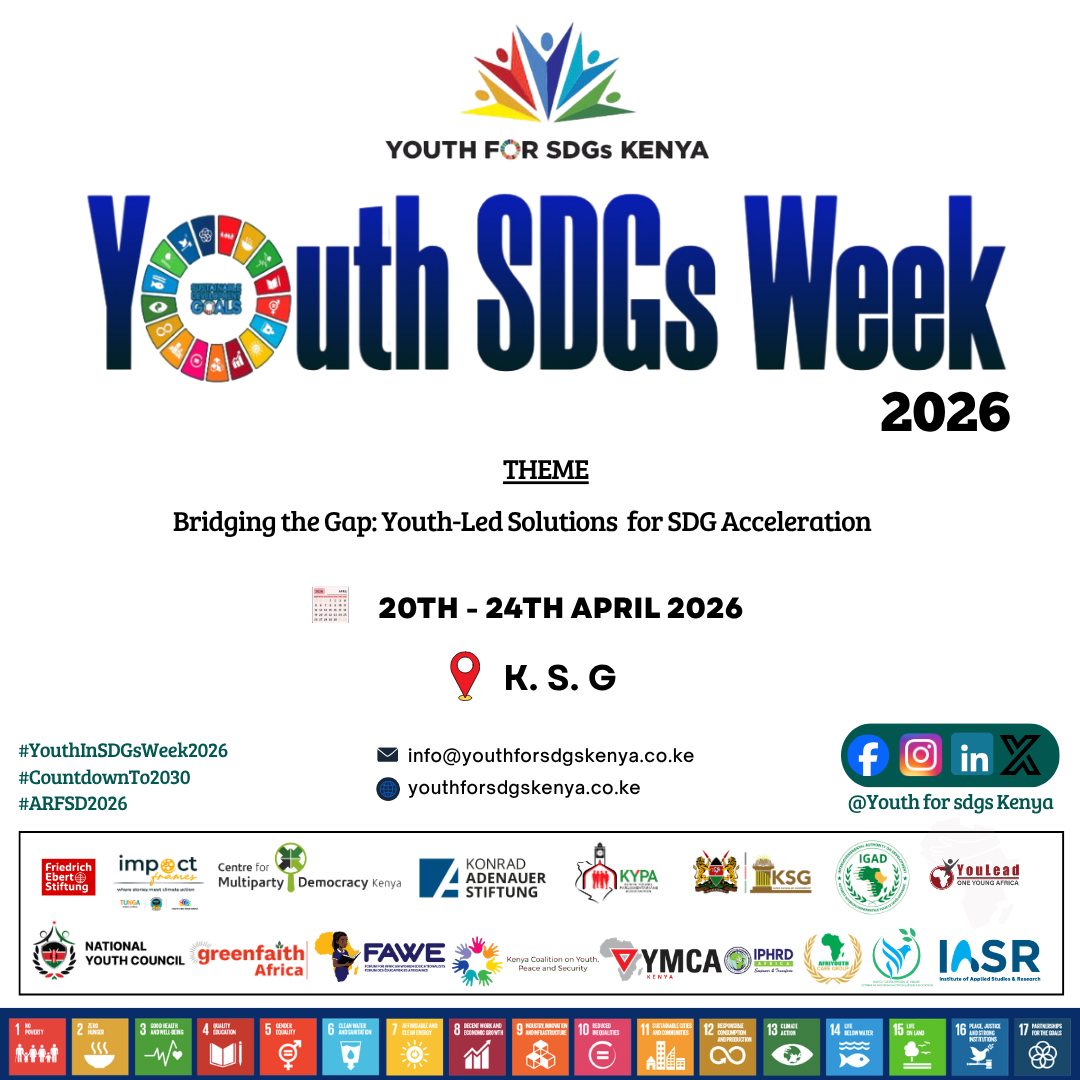
Bridging the Gap on the UN Agenda 2030 during Youth SDG Week
- 20th - 24th April 2026
- Kenya School of Government (KSG)
The Sustainable Development Goals (SDGs) are often presented as the roadmap to a better future. Yet for many Kenyans, these goals still feel distant and unfamiliar. What is SDG- the SDGs are simply a set of 17 goals meant to make life better for everyone; things like having a job, affording food, accessing good healthcare, and getting quality education. They matter because they focus on the real struggles people face every day, and help ensure that progress reaches everyone, not just a few.
In Kenya today, conversations about SDGs are everywhere from government offices to international conferences and that is where the problem begins. Most people especially in the grassroots level are hardly participants in these kinds of discussions. Hence remain abstract ideas rather than lived realities whereby Kenyans are already experiencing the SDGs daily just without the label. The disconnect between high-level policy discussions and the realities faced by ordinary citizens is evident. At conferences, we often hear terms like “economic growth,” “resilience,” and “sustainability.” Yet people are asking simpler, more urgent questions: Where will I get a job? Why is food so expensive? How do I pay school fees? Why is healthcare unaffordable? To make the SDGs meaningful, we must translate them into lived experiences that resonate with people’s daily struggles. Additionally people see themselves reflected in these goals, they begin to show interest and this is the first step toward action.
Kenya’s SDGs journey tells a story of both progress and persistent gaps. While the country has made strides like generating over 90% of its electricity from clean, renewable sources and expanding access to education and having Universal health care millions are still left behind. Roughly one in four Kenyans live below the international poverty line, with counties such as Turkana and Mandera facing extreme poverty rates of up to 79%. Climate shocks and prolonged drought have deepened food insecurity, leaving 2.15 million people in urgent need of assistance and over 800,000 children suffering from acute malnutrition.
Youth SDG Week (20th–24th April 2026 at KSG Kabete) is more than just an event. It is a bridge between awareness and action. It creates spaces where young people can learn about the SDGs in simple, relatable terms, connect them to real-life issues, share ideas and solutions, and take action within their communities. Most importantly, it shifts the narrative.
To achieve SDGs goals by 2030, we must simplify the message, localize the solutions, and involve people directly. The SDGs are not just global targets. If we want to achieve meaningful impact by 2030, we must start by closing the awareness gap. Development is not something that happens for people, it must happen to them.
As we approach 2030, one of the greatest barriers to achieving the SDGs remains limited awareness, particularly at the grassroots level. Youth SDG Week aims to bridge this gap, ensuring that the conversation moves beyond boardrooms and websites, and translates into real impact for those most affected, especially young people, marginalized groups, and grassroots communities.